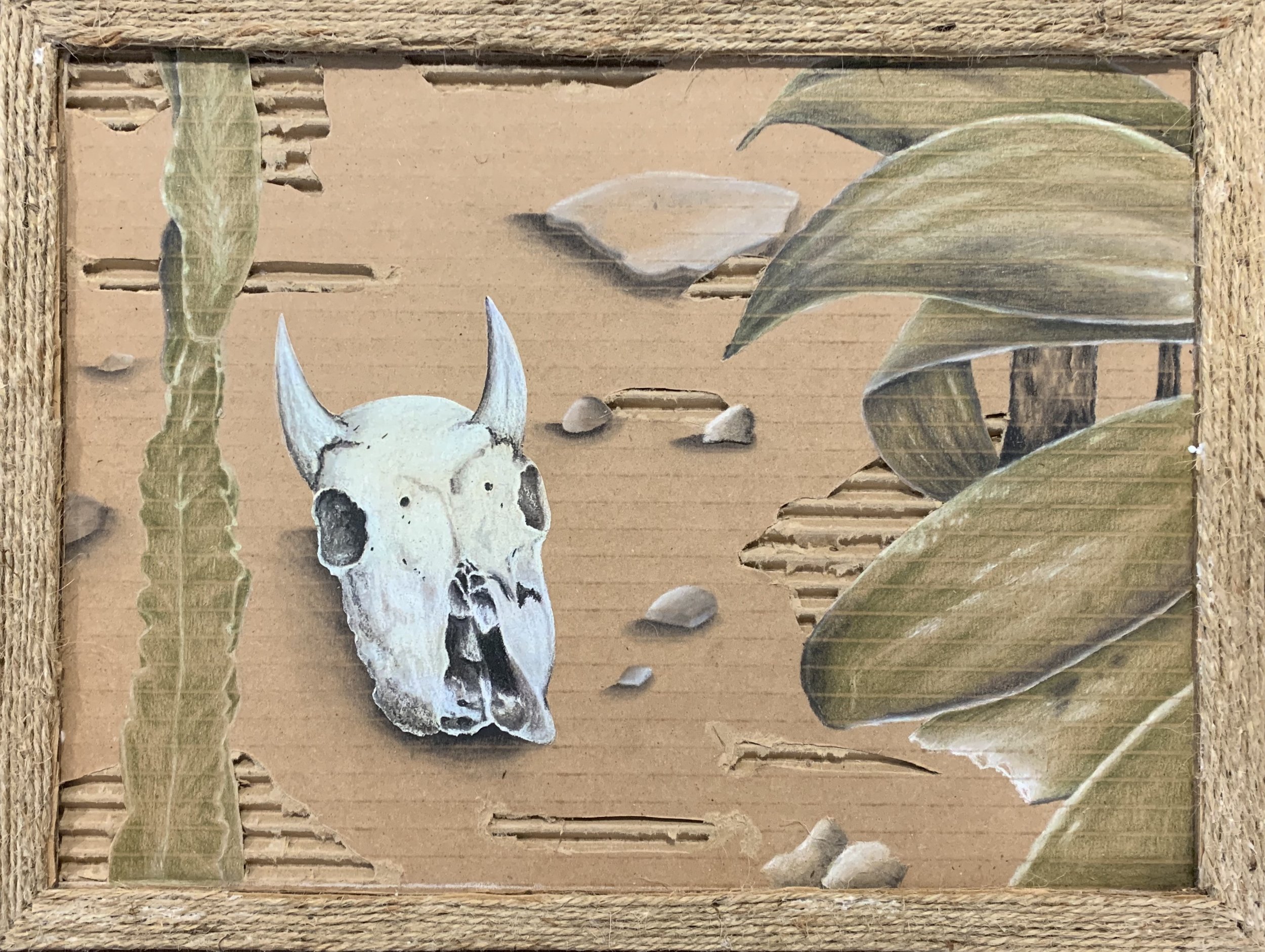
On Broken-Down Cars & Eating Fruit

Art by Haley Osier (2021 archive)
Perhaps I should have swerved around that indeterminable object in the road, but what was I to do? It was rush hour on I-24; I was surrounded on all sides; it was unavoidable—this is how my 2006 Hyundai Sonata and I found ourselves stranded on the shoulder of the interstate with a blown-out tire on the first day of summer. This is just great, I thought, stepping out of my car in a sort of daze. I didn’t know anyone in Nashville to call—I had just split up with my boyfriend, the only person I knew who lived there permanently—and somehow I had to be home in Chicago the next morning. My shoulders slumped as reality set in; cars whizzed by impolitely in the next lane over, impervious to my misfortune. Utterly helpless and with no better ideas, I hopped back in my car and began the trek, at three miles per hour, toward the nearest exit. Of course I knew it wasn’t safe to be driving on a blow-out—I could damage the rims and be out thousands of dollars—but there was simply no way I would be changing a tire on I-24, so for better or worse, I rolled through the exit and pulled into the nearest parking lot: the sketchiest McDonald’s I had ever seen. Perfect, I mused. At this rate I’ll have been kidnapped and murdered before I’ve even started.
As luck would have it, though, no one bothered me while I rummaged through the trunk, hauling out every dusty, half-forgotten piece of trash that had accumulated over the years, just to get to the jack and the spare. I hadn’t ever changed a tire before; I was working entirely off memories I had from driver’s ed in high school (which were foggy at best), but I was determined to achieve this feat on my own, if only out of pure spite. After an hour of wrestling with lug-nuts and fighting the jack (which was conveniently missing a screw), I stood up, legs shaking and hands blackened with grime, to admire my handiwork: an undersized, slightly deflated donut tire, clinging to the axle as though it were a training wheel. It was a sorry sight, but I didn’t have time for self-pity. Without another thought, I got back on the highway, en route to the Windy City. Some may argue my choice to drive the remaining four-hundred miles to Chicago on a donut was even more brazen than risking my life in a McDonald’s parking lot, but—oh well. I did it anyway.
*
I didn’t belong in Chicago; I’d known this since I was twelve. Life had not been kind to me there. The city itself felt like a gaping open wound, or perhaps like someone you’d loved your whole life, who’d brought you nothing but pain. Trauma greeted me with a wide, malicious grin as it held open the front door upon my arrival. The air smelled burnt and unfriendly, as if something once warm had long-since soured. This was no home. I had predicted I would feel this way and had planned accordingly (escapism was a talent of mine; I’d learned early to plan an exit before the damage could settle). I would stay in Chicago for no more than a week; after that, I’d made arrangements to spend the summer living with a family of complete strangers back in Tennessee. Within a few days, I’d said my goodbyes and hit the road again (on a new tire this time).
I drove the grueling eight hours in one straight sitting, as if someone had lit a fire beneath me. When I arrived at the home of my hosts, it was late in the afternoon; the sun had reached its peak in a cloudless sky; the neighborhood bustled with life. The children played happily with the neighbors outside, in celebration of beautiful weather—darting through sprinklers, kicking beat-up soccer balls through imaginary nets; their father stood at the curb, deep in conversation with the mailman, whose cap tilted playfully to one side as he chuckled at something I couldn’t quite hear; their mother, who had noticed my car pull up alongside the driveway, leapt from her lawn chair, throwing her hands in the air with excitement. She rushed to help me with the trunk, unable to contain herself. She’d been slaving over dinner, she told me, so that I could eat quickly and rest. She’d made my bed with the softest sheets she had.
The family was kind enough, though we didn’t have much in common. We ate together in an awkward and uncomfortable silence, while one of the kids—the youngest, who had jet black hair and curious eyes—kicked my chair under the table with relentless enthusiasm. I ate quickly and headed to bed, grateful for an excuse to retire.
The spare bedroom I was staying in was painted bright pink and adorned for a Disney princess—not exactly to my liking, but I was thankful nonetheless. I sat down at the vanity, catching an unavoidable glimpse of my reflection in the mirror. I put my hands to my cheeks and ruffled my hair; the woman staring back at me seemed odd and unfamiliar. What the hell am I doing? I admit, I had not expected to feel so forsaken. I had thought it would be empowering—leaving everything I knew to create a life for myself, on my own terms—but already it felt as though I was misplaced here. I just want to belong.
Each day was more of the same. Wake up, work, eat, sleep, repeat. There was no comfort in the repetition—I was beginning to feel hopeless. Just when I thought it couldn’t get any worse, the summer’s next Great Tragedy struck: on the way home from work, I hit a deer on the backroads and found myself, yet again, stranded and alone, with nothing but the steady pulse of hazard lights blinking in the stillness. At this point, it seemed to me I had somehow incurred the wrath of God, who had made it His mission to make certain that my poor little 2006 Sonata did not escape this summer alive. Had I done too much gossiping? Had I told a white lie to get an extension on some assignment? Was the past year of not attending church finally catching up to me? Two things were certain: there was a dead deer in the road, and the hood of my car had seen better days.
God must have decided to spare me, though, because I’d gotten incredibly lucky. Though I’d hit the unfortunate deer head on going fifty, I had struck it in just the right place. The windshield was intact, the airbags hadn’t deployed, and as far as I could tell, there was no damage to the radiator—I couldn’t look at it, obviously, the hood was crumpled shut like a soda can, but nothing seemed to be steaming, leaking, or exploding, so I took that as a good sign. I sat behind the wheel for a moment, half expecting the car to spontaneously burst into flames, but I was met with nothing but the hum of the engine, still turning over, steady and alive. I took a deep breath and eased back onto the road, leaving the doe where she lay.
*
In the coming weeks, I began to see my car as a cruel sort of metaphor: a symbol of my solitude. I carried it everywhere I went—drove it to work, to the gas station, the corner store. When people asked what had happened (Oh my god, what happened to your car?) I was praised for my independence and resourcefulness—but I was not proud, and I did not feel accomplished. A beat up old car was nothing close to a trophy. It was a testament to my loneliness, a memorial for the life I had dreamt the summer would hold. I had concluded that home did not exist for me, that I was destined to roam and not belong anywhere—that there was not space for me, that I must go on alone. It didn’t bother me anymore; I had accepted it, relished in it, even. I began to take pride in being different, so different I belonged with no one.
On a slow, sunny morning in June, everything changed. A classmate I had grown somewhat close to the previous school year—her name was Dallas, like Texas—reached out to me: You back in Nash yet?
I stared at the message, stunned. I had been so convicted in my loneliness that I’d forgotten she lived in Nashville. Another ping and a second message: I’m just at home. Come eat fruit with me?
I stifled laughter. Come eat fruit with me seemed such a silly thing to say, but so authentically Dallas. It was the kind of thing I had forgotten people could ask—an invitation to just be. I hesitated, hovering my fingers over the keyboard (after all, I’d only recently decided I didn’t need any friends) but my stomach betrayed me—I hadn’t been able to afford much in the way of groceries, and fresh produce sounded divine. Surely a bowl of fruit couldn’t alter my destiny, could it? I got dressed and hopped in my beat-up old car.
Dallas greeted me at the door, grinning ear-to-ear. She practically glowed with excitement, as if seeing me was the best thing that had happened to her all week. Of course, she was always smiling, always radiating effortless enthusiasm. I remembered this about her, the brightness, the contagious lust for life. I couldn’t help but smile, too. I’m so excited you’re here! she beamed. Come in!
The house was quaint and comfortable. Out on the porch, a Bluetooth speaker blasted her favorite summer songs, while a bowl of freshly cut fruit sat on the table, welcoming us to indulge.
“Hey,” Dallas said as we ate. “I forgot to mention—we’re going to visit my friend Jack today. He’s moving to Chattanooga this summer, I want to see him before he leaves.”
I nearly choked on a strawberry. I wasn’t prepared to meet anyone new—my hair was unruly, my outfit was a last-minute disaster, and worst of all, I hadn’t showered after work; I was certain I smelled absolutely horrid.
“You’ll love him,” Dallas reassured me, almost as if she had read my mind. “He’ll love you.”
I wasn’t convinced. But Dallas’s smile was patient, unwavering.
“Alright,” I reluctantly agreed. “But can we take your car?”
*
Jack was a kind and incredibly welcoming soul. He opened his door as Dallas did, with that same type of infectious energy: his eyes sparkling with curiosity, his fluffy blonde hair tousled and sunkissed. He introduced me to another friend: Olen, named after a viking, who had a friendly smile and kind, easy eyes. We swam in Jack’s pool and shared Thai takeout as the sun dipped below the trees. They didn’t care that my hair was not done and my clothes did not sit right, nor did they seem to notice the lingering odor of my long day at work. I left Jack’s with a feeling I couldn’t quite place: a warmth that seemed to stem upward from the soles of my feet, reaching toward the center of my chest.
The four of us grew close quickly. They were like lost puzzle pieces I had been searching for under the carpet and in the cracks of the couch; I had not known completeness until I found them. Dallas and I made frequent road trips to Jack’s new house in Chattanooga; we’d take my Sonata most times, and I’d laugh and retell the story of my blown-out tire every time we passed that stretch of I-24. That loneliness felt distant now; I had left it somewhere far behind me. Perhaps I had accidentally tossed it out the window with a cigarette butt on one of our drives. It called to me from the shoulder of the interstate, but I heard nothing.
In the following months, I came to meet the rest of their friends: Sergei, who was fluent in Russian; Lucas, who was in flight school; Lily, who seemed to resemble a fairy; Benton, who played the banjo; Meryk, who had a kind smile; and Theo, who did their own tattoos.
It was there in Chattanooga, at that little house on Vine Street, that I began to discover belonging. Vine Street, where we broke all the rules: smoked indoors, let cats walk on counters, left all the windows open. Vine Street, where I saw a new face every day, each as warm as the next. Where we sat on the floor and poured cheap wine into mismatched glasses from several fine China collections, where the dishes piled up, and the screen door never quite closed. In the mornings, we’d make eggs in the kitchen, dancing barefoot across the tile. Singing Ella and Louis. Burning the toast.
One night at Vine Street, I found myself sitting alone on the roof. Laughter wafted through open windows from the first floor—muffled music, the clinking of glasses, someone singing off key; there must be a gathering downstairs. I pondered going down to join them, but decided against it. I was content in my solitude here, as the breeze filtered through my hair and offered a cool kiss on my exposed shoulders.
“Mind if I join you?” a voice pulled me out of my trance. I turned to see Jack, wearing a silly grin as he poked his head out the open bedroom window.
He had climbed out before I could answer, settling beside me without a word. One of the house cats padded out across the shingles and snuggled up in my lap, purring steadily. Somewhere in the distance, early Fourth of July fireworks bloomed in bursts of color, just visible over the trees. Their echoes were nothing but a whisper, only faintly audible over the commotion downstairs.
“You know,” Jack said, breaking the silence. “I feel like a person when I’m with you.”
I thought there might be more, but he left it at that.
I feel like a person when I’m with you.
The statement hung in the air expectantly, as if it wanted me to reach out and grab it, to hoard it for myself. Instead, I let it sit there, let it join the fireworks and erupt into strands of smoke that seemed to shower the earth.
*
Jack moved out of the house on Vine Street at the end of the summer, but we often went back to visit. The living room still bustled with life, and the mismatched glasses were still perfect for cheap red wine. Olen ran a radio show in Nashville, and invited everyone he knew to sit with him from ten to eleven p.m. every Sunday. Dallas had new friends over to try making kimchi. Lily and I went dancing on Tuesdays. Life went on, and with each day came more and more people who belonged.
In May, I would’ve told you it would take a miracle to find a place for me, that some people were destined for life alone. In August, I would’ve told you not to worry—that I’d found my place, and you would, too. Now, I’d pull up alongside you and tell you to hop in; the car’s a little beat up, but it’s only a scratch—Sergei fixed the bumper and—I know some people you’ll love. I know some people who will love you.
I often find myself smiling at the memory of that fateful text message: Come eat fruit with me. Such a simple request, such an innocent invitation. Come eat fruit with me. There was space for me in the kitchen; there was enough fruit for both of us. Come eat fruit with me. There is a place for you here.