

Elegy for the Deer of Highway 66
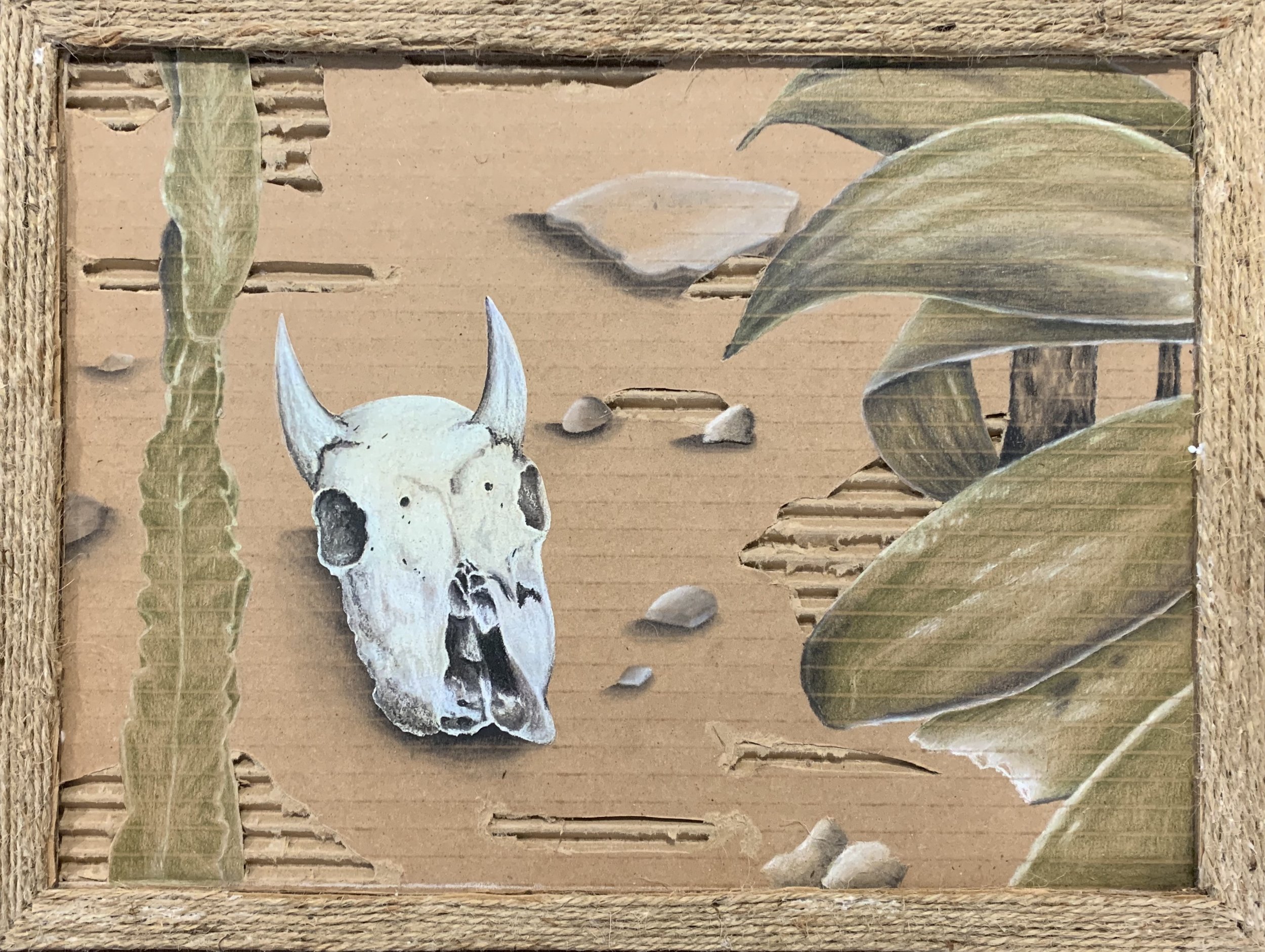
Art by Alli Devolve (2023 archive)
It was Jules’s birthday and Parker wanted to pick flowers. I knew the best place in town to find wildflowers was on the side of the highway. Scissors in my right hand, I held the base of the stalk with my left and watched the blossom fall—limp and useless the moment the stem was cut. I plucked the flower from where it had fallen and twirled it around with my index finger and thumb. It glowed in the sun, vibrant despite just having lost its life. I added it to the rest of my collection and continued down the road with Parker.
She saw it first. Gasped, froze, almost dropped her little wildflower bouquet. I noticed not a second later. The poor thing, so small and innocent, all twisted and bent and swarmed by flies. I averted my gaze immediately, looking frantically up and down the road, as if the murderer would’ve thought to linger. Parker was just saying, oh my god, oh my god in a breathy, gaspy voice. It was October—the sun hung low, the mill pond glimmering with light in between the shadows of the ponderosas. The fawn couldn’t have been more than four months old—she was still dappled with the imitation of this light. Her fur mimicked the changing of the maple leaves. Her eyes were wide open, flies already pushing past the curtains of her eyelashes. She was looking up at the sky, that perfect, vibrant blue reflecting in her deep, empty eyes.
Did you know that your eyes glow in our headlights? Little hopeful stars poking out of darkness.
There was little wind, I remember realizing. Despite their mirrored selves in the water, the trees did not waver. The blue-green hammocks across the pond were still. The roadside wildflowers danced only as a truck came cutting through the scene. The truck snapped us from our stupor. That little body. That little body and its full stomach, strong legs, a body loved by a mother devoted enough to risk the road. Suddenly, to us, it felt that nowhere was safe. We fled to the garden lost and dumbfounded, stumbling away from the highway where such acts of injustice are frequent and normalized and nothing worth lingering around for.
A highway: a thick line cutting through continuous land.
*
Meanwhile, the world kept on without us: there’s Keith riding down from the old logging road on his bike, and the sound of wheels on dirt was as if he were right beside me. Henry split wood in the maintenance yard and the sound of axe meeting heartwood was not an evil sound.
The sun hid playfully behind a ponderosa before beginning again its sweeping slants across the earth, still ripe with energy. There it went over the pond, over the ponderosa grove, over the hammocks. A carp breached the water, landed and sent echoes across the pond. A group of Steller’s jays squawked as they jumped from cedar limb to cedar limb. Our milking goats bleated in their pens, and the chickens made a sudden commotion. At the same moment, a plane shot up from the treeline, leaving a swirling, pure white trail behind it. A hundred people were there. Maybe two hundred. All passing by.
And then there came another car, the sun sharply reflected off the windshield, throwing the wildflowers east as it went. And Keith, bathed in this pulsing light, completed his loop around our little logging town and continued on. Henry split a log into three with one downward swing. The birds still sang, the sun continued to sink, the town went on. A family of three picked their way along the far side of the pond. Little, clumsy hooves followed behind their mother, utterly devoted. And while the world kept churning, the dead fawn was taken by loving hands to be buried deep in the forest. A ritual done whenever a body becomes a victim of Highway 66.
A highway: a reckless, absurd thing.
*
We returned with a sunflower, the last bloom of the season. It was downcast and slouched. The flower was already wilting. There wasn’t much to say; we walked in silence, back to where we had found her. Except, in the twenty minutes between our discovery, the subsequent rush from it, and our mournful return, she had been picked up and taken away. We did not know where she went. That body, that little, loved body, vanished, the only thing left being the swarm of flies, flattened earth, and a single tuft of dotted fur.
Parker placed the sunflower where the young one had just rested, and our hands found each other as we held a moment of silence. I felt the world’s injustices weighing on my heart. This was not the first reminder of death I had had that day. It seemed to be hanging in the air. All I felt I could do in the moment was say a little prayer, willing it to be true: I hope death has a kinder heart.
The wildflower bouquets sat on Jules’s windowsill for three days, vivid and hopeful, caught in their last, dying glory before the long winter.


