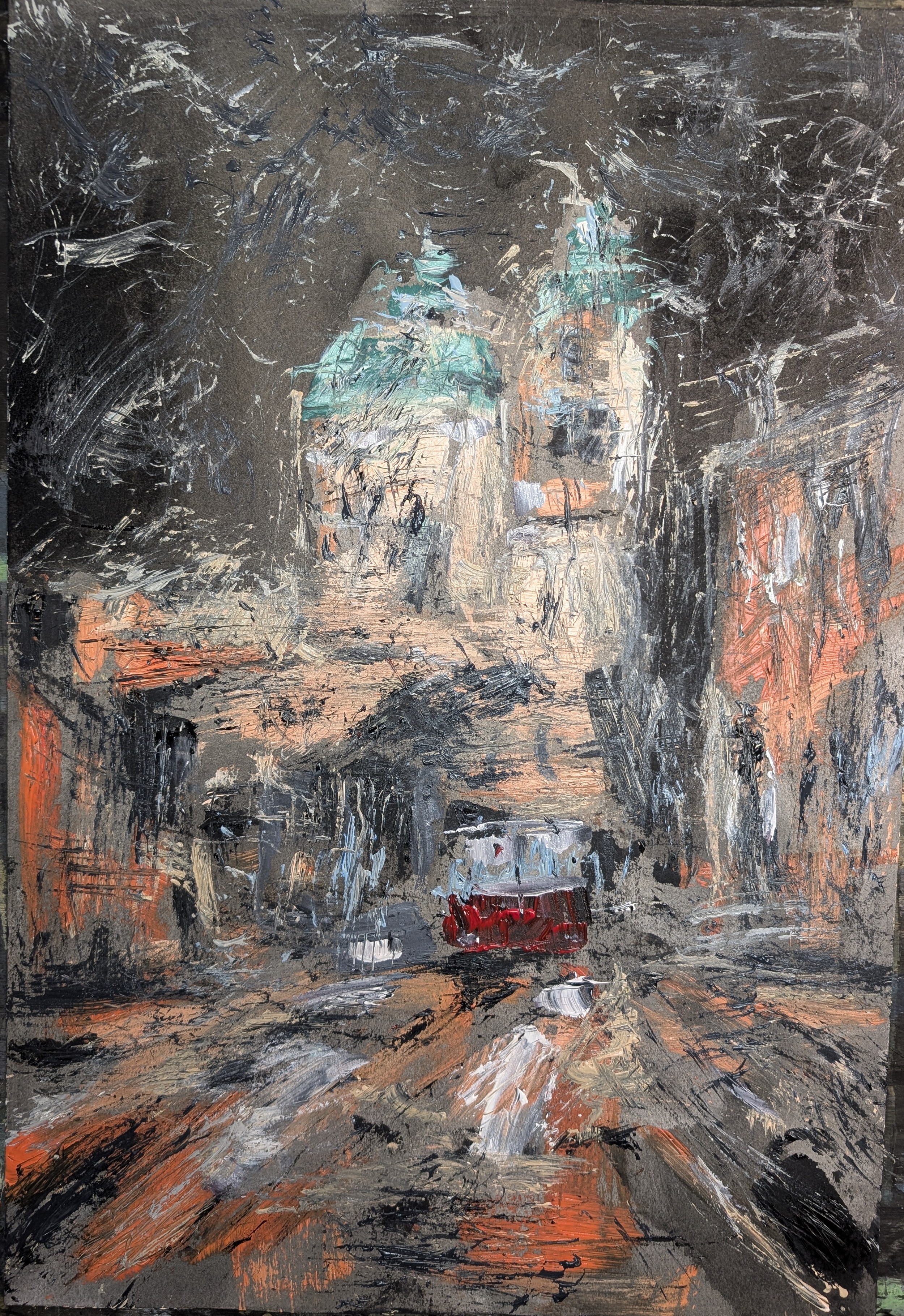
Everything a Magpie Stole from Me at Mirror Lake Park

Art by Mikayla Knape (2020 archive)
A piece of my muffin.
I could have been fine with it if it was an isolated incident. I got to my bench at ten to read, as I usually do, because I enjoy reading around trees on Saturday mornings. I’ve done so for years with no protest from any of the other park-dwellers, animal or otherwise, but for whatever reason, a bird decided to pick a fight that day. It was a blueberry muffin, and I had wrapped the last bite in wax paper, saving it for when I finished the next chapter of Moby Dick. It was a necessary reward because it’s Moby Dick and I was only reading it out of spite, because one time Hazel told me it was the longest book in the world, and even though that’s not even true and nowadays she’d never know I was reading it, I felt like I had something to prove. Right in the middle of the chapter there was a blur in the corner of my eye of black and white feathers, and the next thing I knew, the muffin was gone, paper and all. I looked around, confused, seeing nothing. A distant chittering bounced between the trees that border the park. I’d like to say that I was slow to anger when it came to the bird, and that I was just as worried about how well birds can digest muffins as I was about losing half my breakfast, but I’d rather not lie. Though I didn’t dwell on it for too long, the bird had made my day just a little worse. I threw out the rest of the muffin, in case it had a disease or something, oblivious to the war that had just begun.
My last cracker.
“The last one’s always the best in the packet,” Hazel had once told me, in the days when we were still close, when the summers seemed to come around much more often.
“That makes no sense. Say you’re packaging crackers. How does that even happen?”
She had just shrugged, and that had been that: we’d invented a new kind of miracle.
A hair tie.
It was windy that day, too. The trees at Mirror Lake swayed and I had to leave early because my hair kept blowing in my face. I could barely see the page in front of me.
A pen cap.
This was when my suspicions started to grow. It felt more personal this time. To me it seemed that a pen cap was useless in every way other than its desired function. Stealing a hunk of plastic didn’t benefit the bird at all, but it did mean that a giant blue stain appeared in my coat pocket a day later.
It was an old pen I’d found on my desk a week before.
I wondered how insane it would be to start doing research on bird thievery. I knew that nearly every bird gathers sticks to make a nest, but there were far superior sticks elsewhere as far as I could tell. That plastic was neither edible nor a treasure, no matter your perspective.
Hazel probably could have cracked the code. She was always making elaborate stories to explain ordinary things, like the journeys that pennies went on from pocket to pocket, or how our #2 pencils had seen and written secrets not known to another soul. She could have come up with a reason for some bird to take my pen cap, one that was somehow noble and aspirational.
“Maybe the bird is trying to rid the world of plastics,” I would have offered, “Maybe it came to the park after its home was destroyed, and now this is its way of making sure it never happens again.”
“Yes!” She’d say. “And here’s how it started.” I did try on my own to imagine what all of the possible backstories were, just to humor myself. Maybe it was revenge against a ballpoint pen that once did the bird great wrong. Or the bird mistook it for a strange but delicious variety of bug. After I found that giant blue stain, however, I narrowed down all of the possible motivations to one: pure, distilled spite.
I told myself that it was silly to assume this was the same bird from the weeks before, but secretly I had decided that it was. I had also decided this bird was both intelligent and evil.
A second muffin. Poppyseed this time.
It was absolutely the same bird. Every time it trotted away, with the whimsy and spite of a thousand of the worst children you know, I caught a glint of blue amidst black-and-white wings. Not many birds around here looked like that. There was a sign at the park entrance, tinted green from moss and pollen, that displayed all of the birds for identification: there were cardinals and robins, their bellies faded to orange in the sun, and they were not blue at all. There were bluejays—too blue. I could have imagined the blue. The thievery made me think of magpies, but I always thought magpies were supposed to take valuable things.
Now that I was confident it was the same bird, more troubling questions emerged. Why me, and why now? I had not suddenly encroached on its territory. I’d been going to this park since Hazel and I were the Band-Aid-wearing age, that age when you scrape your knees so much that you start avoiding the purple bandages when you reach for the box because you want to save your favorite color for later. We’d always ask to go to this park in the fall, when the creek was at its driest so we could play in it, jump between the rocks without fear of getting our feet wet, collect pebbles that would usually be at the bottom, unreachable below the current. We’d make up stories together, pretending the creek was the ocean, or a vast river, or a canyon. We were explorers, pirates, nobility. Or we were just us, but somewhere else. We’d sit on this picnic bench to eat our lunches (easy sandwiches and crackers that tasted faintly of the hand sanitizer our parents made us use) and plot the next part of whatever saga we were playing out.
“And then we find the treasure.”
“No, we can’t do that yet!”
“Why not?”
“Because then it’d be over, and we’d have to go home.”
Now, I just came here to walk or read. Sometimes I wondered if Hazel did the same, if one day I’d run into her here and it’d feel like when you run into your teacher at the grocery store. I worried about that sometimes, that running into each other now, and only briefly, would make everything so much worse. So far, I had worried in vain. If she did still come to the park, I never saw her. She must have sensed that Saturday mornings were mine.
The bird had no such reservations. Each theft felt targeted. I could tell that creature knew something about me, and that it planned to use this information for the sole purpose of ruining my morning.
A bookmark, yellow construction paper and sharpie, which has, in bad cursive, the words “Start again here!” and an arrow.
It sped through the sticky underbrush, a blur of black and white and blue, with a flash of yellow paper folded in its beak. My stupid bookmark. It was just sitting there, looking nothing like a muffin, and then it was gone. “I liked that one!” I shouted after it, even though I didn’t, but the bird was already high in the trees. That was six times now.
It wasn’t really about the bookmark, which had been a grating annoyance to me for a long time. It was too chipper, and made me a little angry each time I opened the book with its cheeky guideline and the aggressively bright shade of yellow that had (until now) kept me from losing it. Now that it was gone, I could remember that I made it in fifth grade out of construction paper, and that it had never once failed at keeping my place on a page.
I was surprised to remember the day I made it. It was supposed to be a fun craft, probably on the last day of school, something to occupy us so we wouldn’t ransack the place with the pent-up excitement for summer. It was probably supposed to be calming, but I had rushed through the craft, not knowing how much time there was left in the day. I thought of something sort of clever to say, wrote it down as quickly as I could, and called it a day. Next to me, Hazel had been carefully gluing magazine cutouts of iris flowers onto her bookmark. “Oh,” she said, looking over at mine, “That’ll definitely come in handy sometime.”
“Thanks. Why the irises?”
“Irises mean ‘fire’ in the flower language,” she told me. “There was a page on flowers and meanings somewhere over here, before I cut it out. Most of the other ones mean ‘love,’ or ‘friendship,’ or ‘thoughts,’ but irises mean ‘fire.’”
“I like that.” I don’t know what it made Hazel think of, but I imagined a posh woman in a Victorian dress, striking matches and letting them fall to the ground.
I watched my yellow bookmark flit away in the bird’s clutches, mad not about its loss but the principle of the thing. And what kind of ugly nest was it making? Unsettled, I decided the only thing to do was to keep on reading, though it felt more like letting my eyes float from line to line while I checked my peripheral vision for the stupid bird. It could not scare me off, I decided. This was my reading bench, and it would stay that way.
A piece of gum, which the bird immediately threw into the creek.
It would feel stupid to have a grudge against a bird if the same bird didn’t have the same clear and completely unfounded grudge against me. I wanted to tell someone, but only if they’d shake their heads somberly and say, “yes, that bird is so cruel for no reason,” and take it as seriously as it should be taken. This was why I hadn’t told anyone, because I had the feeling instead that they’d laugh at me. I’d have laughed, if it had happened to anyone else. If Hazel had told me about this, I’d have fallen out of my chair laughing. She’d know just how to tell it, too. She’d build to the moment of the theft. I’d lean in, then jump in my seat as the bird attacked. She’d describe the race through the jungle like a high-speed car chase. My shoulders would tense up as she told me, and then she’d remind me it was just a bird and we’d both burst out laughing all over again. The laughter wouldn’t have stopped me from telling her. Hazel could laugh at serious things without making them unimportant.
Then. It wouldn’t have stopped me from telling her then. Then, we’d have celebrated the drama of it all. Now, I don’t know what we’d do. I imagine us sitting across from each other at a coffee shop and the only thing I can think of to fill the silence is more silence, or such complete earnestness that I’m reminded it’s all in my head, and I can’t tell myself what she’d say. It’s impossible. I’ve never once known what Hazel was going to say next.
The last five pages of Moby Dick.
I couldn’t make this up if I wanted to. I was almost finished, I was so close, and as if on cue, the fiend swooped down right in front of me and tore the final pages out of my book just as I was about to read them. The last five pages, when everything happens. To say I had been reading for pleasure would be an unfair estimate of my stubbornness, but I wanted to know. Instead, I watched those pages fly away, held slightly crumpled in the creature’s glistening beak. That time I’d actually gotten up and run after the bird, panting and letting thorns and sticks scratch at my clothes, but it had disappeared all the same. The scratches stung. When asked if I believe in ghosts, I still hesitate, but this stinking bird makes an excellent argument for demons.
After failing to chase the bird down, I started the list. I clearly could not catch the thing, but picking a new bench would be surrender. The economical thing to do was channel all of my resentment into an inventory.
Another muffin. Blueberry again.
I tried my best to shield it, but the bird snatched the pastry right out of my hands. It had grown comfortable with me, like a friend who steals your fries from across the dinner table, who you forgive because you already took a few of theirs when they were turned around. Except there seemed to be nothing I could do to get back at it.
“What did I ever do to you?” I called after it. My grudge was becoming more reasonable by the day, so long as I didn’t have to explain it to anyone.
Several feet of orange yarn, from when I tried to knit and quit almost immediately.
I’d been too confident when I’d first tried to learn, and I got the yarn tangled instantly into knots I didn’t want. A perfectionist, I quit soon after. I had thought I could make Hazel an orange scarf by the end of the week, but that was beginning to look like an impossible task.
“Don’t worry so much about getting it right,” Hazel told me one time as we walked around the park, too old to go in the creek, but just the right age to watch the sunlight turn green when it hit the canopy. “I didn’t get how to do a cartwheel right away.”
“You still can’t do a cartwheel.”
“Well that was a bad example, because I quit.”
“So I should quit.”
“That’s not what I meant.”
“Do a cartwheel, then.”
She shoved me off the path instead, and I feigned collapsing onto the ground as if I’d been sent spiraling into the grass. “Come on, get up.” She reached out to help, and I pulled her down with me. By then we were laughing too much for me to tell her that, seriously, I really couldn’t screw up the scarf, not because I couldn’t screw up but because it was for her.
After all the trouble, the bright orange yarn had disappeared into a drawer until I’d decided to teach myself to tie knots. It hadn’t been going well when the bird swooped down and crushed all of my promising prospects in the world of knot-tying. I was so careful that time, too, hunched and guarded over my project, but I left a loose end trailing over the side of the bench. I quickly lost the resulting tug-of-war.
A pack of sugar.
From a coffee grabbed long ago, as a pretense.
“I’m stealing sugar packets from here,” I told her. “I have been for years. I have a hoard.” “Sweet,” she said, and I rolled my eyes.
Another trail of yarn, this time tied into an impressive knot, although not the one I was trying to create, nor one that I even begin to have the qualifications to untie.
It almost felt like a favor.
A protein bar.
Replacing the muffins did not help me keep anything. “What do you want from me?” I yelled at it as it sailed above my head.
It made no response. Instead, I made up a few of my own.
“I want to bother you, nothing more, nothing less,” it said. “I have a purpose that will always bother you but never reveal itself,” it said. “I’m hungry,” it said.
Two pennies, a dime, a nickel, and a quarter.
I’d left some change next to me on the park bench after having to dig around a bit in my bag for the (new, non-mutilated) book. I’d thought it was safe to leave out (what was a bird going to do with loose change?) but before I could catch my mistake there was a flash of black and white, with such a slight hint of blue that it could have been a trick of the light, and then just like that I was short forty-two cents. I’d gotten most of it from various sidewalks. Hazel used to call me a penny-picker-upper, but I’d picked up the habit from her. Back when we walked to school together, she would hold out her arms and stop me in my tracks.
“Wait!” she’d declare, as if it was vital we wake the whole neighborhood up. Then she’d lean down and pick up a tarnished little circle of bronze, and slip it in her pocket. “Okay,” she’d say, and take a breath. “What were you saying?”
“I forgot. Nice penny, though. What year is it?”
She slipped it out of her pocket again, squinting. “2012. Where do you think it’s been?”
“In pockets and cash registers, mostly.”
“But which cash registers and pockets?”
“What about all of them? Do you think I could have made it to all of them since 2012?”
“The real question is, why would it travel so far just to come to this sidewalk?”
We’d make stories, each more and more elaborate than the last, about how it ended up on the sidewalk. Though the truth was probably mind-numbingly boring, we tried to make it sound like an epic quest of trials as the penny fought to be freed from its endless exchange for goods and services until it finally found a hole in its owner’s pocket, a crack in a window, the right angle from the folds of a wallet, and made its leap of faith.
No, I was wrong. I hadn’t picked up those particular coins; I had grabbed them from a counter. It was change for a coffee: I’d put the bills in the tip jar and kept the coins.
“A weird tipping habit,” Hazel had said, trying to laugh, hoping it would get me to smile back at her.
“Yeah,” I’d said, letting my short responses put an end to it. I tried not to look her in the eyes that day, and she tried so hard to look into mine. She tried, when she really wanted to. The same couldn’t always be said for me. We talked about the weather, I think, and then all of the fake things that we always talked about. She asked what year my pennies were minted. I asked her what she was reading; she always happened to be reading the book I planned to read next. Our conversations had never really been about “how are you?” or “what was the week like?” We had known each other too long to talk in terms of time, especially that day, when we knew we were running out of it.
There was never a huge disagreement between us, no giant falling out that could make us both feel better about growing apart. Neither of us moved away, or betrayed the other, or fought. Maybe it was a collection of undetectable things, one particle of dust at a time, floating between us until we each were entirely unrecognizable to the other, but one day we were eighteen and having coffee and there was an undeniable difference. We hadn’t grown up yet. We were also no longer in the same place. It felt as though we had run out of things to say to one another.
A paperclip.
I remember making chains of them together, searching our houses for paperclips as if they were gold, just to add another link to an endless string that we’d drape over doorways until they came crashing down in the middle of the night, the sound just unfamiliar enough to be completely frightening.
Maybe the bird was trying to help me clean out my pockets.
A grocery store receipt.
It was ancient. It must have spilled out from the bottom of my bag. On it, I noted all of the ingredients for blueberry pie. Hazel’s family recipe. We once spent hours one weekend trying to replicate it, without any hints.
“How much butter was it?” asked Hazel.
“I thought this was your recipe!”
“Yes, because I have it written down! I’ll go check it.”
“You can’t check the recipe!”
“Why?” she laughed.
“Because it’d be cheating!”
She’d been secretly checking the recipe and fixing things anyway, but the whole thing had collapsed in on itself regardless. It still tasted delicious. I’d probably remember the recipe now. If I asked her for it, she’d probably still send it to me, but what would either of us do after that?
A rubber band.
Today, I decided to experiment. I grabbed a rubber band from my junk drawer. I had no emotional attachment to the rubber band, no memory tying the rubber band to me, to Hazel, to anyone at all. It was just a rubber band. I left it out on the bench next to me, making sure to position it in a way that I thought would be most enticing to a bird, whatever that meant.
One blur of black and white later, and I sighed with relief at the rubber band’s arbitrarity. Maybe I had put too much thought into the bird’s crimes. Maybe it was just a bird, making the strangest nest in the world. Maybe it was me who was assigning meaning to what it stole, connecting the random contents of my bag to memories I’d tucked away at the back of my mind.
It was only later that day, when I’d already left the park, that I remembered Hazel and I used to launch rubber bands at each other across the classroom behind the teacher’s back.
Nothing.
The most perplexing day of all. It didn’t come within five feet of me, but it sat there, on a branch across from my bench, and watched as I watched it. All of the other times I’d seen it, the bird had been a blur, and now it was as still as could be. I could see the outline of each black feather, the white splotch that was its belly. The tips of its wings were a bright blue that I hadn’t imagined after all. It was unmistakably a magpie. A treasure-hunter.
I couldn’t concentrate on reading. I just stared at the magpie, until it flitted off of the branch. I thought it might disappear completely, but it lighted on the next tree, just a little further from where it had been. It looked back at me. It chittered. Another disturbance of feathers, and it moved just one branch over. It called out to me again.
I set my book aside and followed it deeper into the park.
“Wait!” I called after it, and strangely enough it seemed to listen. I wondered for a moment if it might not be a bird at all, that it might be some kind of ghost. Even as I entertained the thought, a feather fell from its wing onto the ground. I picked the thing up, and it was no more than a feather, a real feather, too prickly to the touch to be illusory.
Following the magpie’s slow, considerate pace from branch to branch, I realized how unfamiliar I really was with this place. The bench I frequented stood at the edge of the clearing, giving way to more rambling woods. Just past it, the creek wound its way around an old oak tree that I remembered from my old summer adventures with Hazel. The tree was old even then, full of knots, its branches cradling squirrel nests, some fallen across the creek after the last lightning storm. The branch across the creek had always been our sign to turn back, that we’d gone too far and would soon get lost. The bird hopped deftly over the oak’s tangling roots and I continued, trying to step over just as carefully, my human legs ill-suited to the task.
The leaves underfoot were still damp from Friday’s rain, the mud still fresh and untouched, the humid air an unwelcome embrace. I could see footprints in the dirt where other birds have been, scurrying from one worm to the next. I heard nothing but my own breathing, the squelch of my shoes in the mud, and the chatter of the magpie just ahead. When I couldn’t hear the chatter, I looked for a blur of blue against the crowns of trees. I followed the thing like someone hypnotized, and I followed only because it had asked. Thorns and leaves grabbed at my shirt, as they had done countless times before.
Then, a few paces away, in the space of just a moment, the bird descended, landing at the base of a tree. It chattered again, glanced at me, then flew. I thought I could catch it again this time, and almost started off running, but it had disappeared so completely that every direction felt more wrong than the others. A bottlecap was missing from my pocket. I had forgotten it was there until it was gone.
I stopped at a tree. It was not as old as the fallen oak. It still reached toward the sky. A tangle of roots gathered under it, wrestling each other before plunging into the ground. Another day and I would have tripped on roots like that. I had a scar on my chin to prove it, as did Hazel.
My eyes followed the trunk upward, and caught on a crook between old branches, like an elbow, just at the height of my shoulders. There was a nest perfectly folded between the branches. It was made of everything. Things that silly bird stole, and things that it couldn’t possibly have found. Book pages, old movie tickets, bright yellow construction paper.
I leaned closer, expecting at any moment to draw back at the sight of a worm or some tree vermin, or to see a cluster of shiny treasures, but I found none. The contents were all mine.
The last piece of strawberry gum (my favorite, then it became her favorite). A ticket to that movie. I remembered. I knew she did. The theater and the time are right, too. There are two of them. Could the other one be hers? A stub of a dandelion crayon. For a while, my drawings as a child were steeped in that yellow. To grow up was to grow out of it, but there sat the bookmark, too, stubborn in protest. I know you. A missing puzzle piece. I remembered the puzzle: rows of colorful socks, 1,000 pieces. I used to pick out which piece would be the final one before I even started, and hide it somewhere. I always lost it, leaving it unsolvable. This was why I got in trouble, this and following strange birds into the forest, probably. I found a penny. A blandly optimistic fortune from a cookie. A tiny note. A muffin wrapper. That pen cap. I kept a diary once, and used my favorite pen, it looked just like that one, but I gave up after the first entry. I didn’t want to make it part of my routine, but despite my abysmal record-keeping, it was all here. I recognized each and every artifact like a face.
“You’re another kind of nosy,” I muttered to the bird, even though it was long gone. Some hoarder, with all of these scraps and nothing but me to show for them. Still, I found myself sinking to the base of the tree, cradling the nest in my lap and picking through the different pieces. I read the last five pages of Moby Dick. For the rest of the morning I found myself wandering the dangerous no-man’s-land between recalling and despairingly reminiscing.
At some point I would get up, place the nest back where it was between the two branches, and find my way back to the park. But for the time being I sat there, picking through these bits and pieces, out of which a few of us had made a place for ourselves, a nest, just for the season. The bird really did have it out for me.
Another muffin (cranberry), neatly split in half.
We have an understanding.


.jpg)